
CORPORATE CHRIST
Saturnalia
From Pagan Reverence to Christian Tradition and Occult Revival

Saturnalia
Saturnalia remains one of the most fascinating bridges between the ancient world and the rituals, festivals and cultural behaviours that shape us today. What began in Rome as a raucous mid-winter festival devoted to Saturn, the god of agriculture, liberation and renewal, evolved over centuries into a foundational layer beneath Christmas, New Year customs, and a surprising number of modern esoteric practices. To study Saturnalia is to examine a civilisation’s transition from freedom to structure, from polytheism to monotheism, from mystery religion to organised church – while noticing that the old gods never truly left; they simply changed their clothes.
This article traces the historical origins of Saturnalia, its social and spiritual symbolism, the ways it shaped early Christianity, and how modern occultists still draw upon its energies today. Throughout, we will see how Saturnalia represents not only festivity, but inversion, rebirth, and the eternal dance between darkness and light.
Origins of Saturnalia
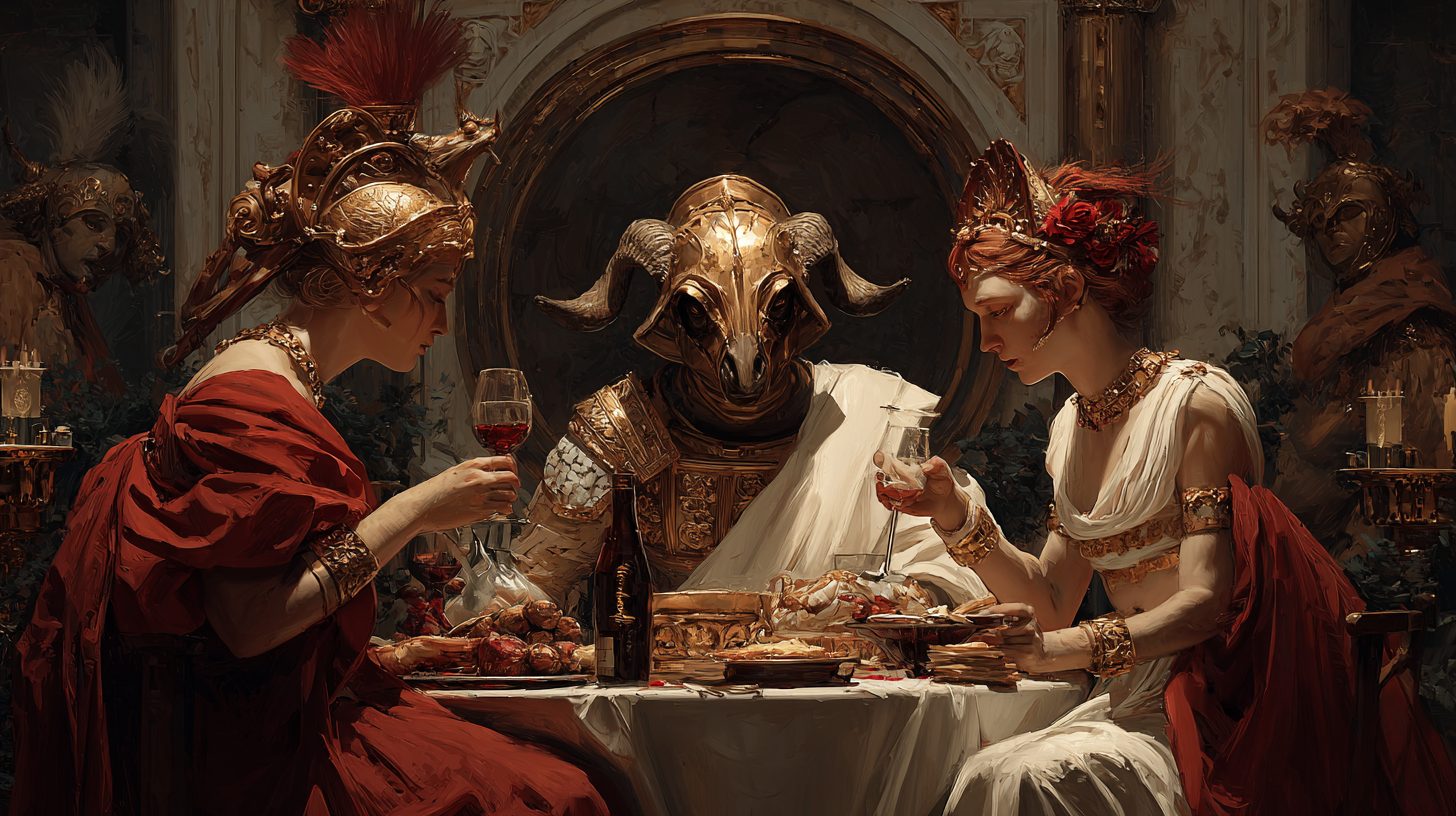
The festival of Saturnalia was held annually in ancient Rome beginning on the 17th of December, later stretching into a week-long celebration. Dedicated to Saturn – identified with the Greek Kronos – Saturnalia honoured the sowing season, the cyclical nature of time, and the fading of the winter sun. During Saturnalia, normal order was suspended. Slaves and masters reversed roles. Gambling was permitted. Public feasting spilled into streets. Gifts were exchanged, particularly wax candles (ceres) symbolising returning light, and sigillaria – small figurines representing human sacrifice offered in place of real blood in earlier times.
Historians describe Saturnalia as an eruption of controlled chaos. For these few days, Rome relaxed its rigid hierarchies, allowing citizens to behave freely without judgement. The state sanctioned misrule. The cosmos itself seemed turned upside down.
At its heart, Saturnalia was an invocation of renewal. In a season where sunlit hours were shortest, ancient Romans brought fire, laughter and community into the darkness with a clear message: light returns. Order will re-emerge. Nothing dies; everything cycles.
Saturnalia and the Theme of Inversion
One defining aspect of Saturnalia was the symbolic overturning of social structure. The lord served the slave. The homeless dined richly. The respectable indulged wildly. Even kings were mocked. This inversion reflected the myth of the Golden Age under Saturn, a time when humanity lived freely, equally and abundantly.
The ‘Lord of Misrule’ or ‘King of Saturnalia’ presided over the festivities, chosen often by lot. He commanded absurd acts, comedic pranks, and satirical performances. His reign lasted only through Saturnalia’s duration, after which he returned to ordinary life – sometimes even to execution, echoing older ritual practices of sacrifice to ensure fertility of the land.
This inversion has echoed into modern celebrations. Christmas crackers, drunken office parties, cross-dressing in medieval carnivals, even Mardi Gras owe a debt to the Saturnalia spirit of controlled anarchy. When people today say “It’s Christmas – let your hair down!”, they unknowingly channel Saturnalia.
From Saturnalia to Christmas
When Christianity rose within the Roman Empire, Church leaders faced a challenge. They found a populace deeply attached to Saturnalia. Rather than abolish it, they absorbed and sanctified it. The birth of Christ, once celebrated in spring, was gradually repositioned toward the winter solstice –
December 25th – conveniently close to Saturnalia’s peak.
This alignment was not coincidence. It was tactical theology.
As Saturnalia honoured the rebirth of the sun, Christmas proclaimed the birth of the Son. Fire became candlelight vigils. Evergreen wreaths became symbols of eternal life. The gift-giving tradition became Christian charity. Feasting became Christmas dinner. Even the idea of a benevolent gift-bearer, later Santa Claus, carries traces of Saturn himself, depicted as an old man with a sickle, governing time and years. Santa’s jolly freedom mirrors Saturnalia’s misrule, while his judgement – rewarding the good, punishing the bad – reflects Saturn as the stern arbiter of consequences.
Christianity did not erase Saturnalia. It baptised it.
Symbols that Survived
Saturnalia resonates in countless cultural elements:
• Gift giving – Sigillaria and toys exchanged then echo today’s Christmas presents.
• Candles and lights – A plea for the sun’s return. Now Advent candles burn with near identical symbolism.
• Feasting and indulgence – Saturnalia feasts evolved into Christmas dinner and New Year parties.
• Role inversion – Boxing Day tipping, office parties, playful traditions where norms soften.
• The Lord of Misrule – Reflected in medieval Twelfth Night, British pantomime, and Santa’s whimsical unpredictability.
• Saturn’s sickle – Transformed into the scythe of Father Time at New Year celebrations.
Saturnalia, in effect, created our cultural winter landscape. Christianity layered theology upon practices that already resonated deeply with human psychology.
Saturnalia and the Occult
To modern occultists, Saturnalia is more than historical curiosity. Saturn, in esoteric traditions, symbolises discipline, limitation, karma, time, and gateways between worlds. He is both the keeper of chains and the one who ultimately frees. Saturnalia’s liberation through chaos embodies a paradox: freedom is born from confronting structure.
This duality is central to many magical systems.
In alchemy, Saturn corresponds with lead – heavy, constraining, but the starting point of transformation. The Great Work begins in darkness. Saturnalia celebrates that darkness not as doom but as potential. Winter is the womb.
Astrologically, Saturn governs responsibility, karma, and the “schooling” of the soul. Yet Saturnalia allowed us to laugh at authority, taste freedom, and recognise life beyond rules. Occult practitioners use Saturnalia as a time to:
• Break habits and rituals of self-restriction.
• Perform banishing rites for old burdens.
• Meditate on mortality, time and legacy.
• Invoke shadow integration – acknowledging the wild self.
• Engage in controlled rebellion – rejecting false authority.
• Celebrate the sacred in pleasure, not just austerity.
In many modern magical calendars, Saturnalia is ideal for shadow work, tarot readings with
The Devil or
The World cards, and meditations on endings and beginnings.
Saturnalia is a reminder that structure and freedom are partners, not enemies. Without winter, spring has no meaning.
The Saturnalia Archetype in Society
Even outside religion and magic, Saturnalia underpins cultural psychology. Humans need ritual release. Without periodic freedom valves, societies become brittle. Saturnalia provided that valve. People played, laughed and inverted roles – then returned to structure with renewed tolerance.
Modern equivalents include:
• Festivals and club culture
• Carnival traditions worldwide
• April Fool’s Day
• New Year’s Eve excess
• Pride parades turning streets upside down
We are still Romans at heart. Saturnalia pulses in our social DNA.
Why Saturnalia Matters Now
We live in an era of pressure, surveillance capitalism, moral fatigue and burnout. Saturnalia offers a medicine our world sorely needs – structured irreverence. Not escapism, but ritual chaos with meaning. A conscious symbolic release. A reminder that joy is not frivolous; it is necessary.
Reintroducing Saturnalia principles could support mental health, community cohesion and spiritual grounding:
• Slowing down and reflecting on time – Saturn teaches long vision, patience and mortality acceptance.
• Celebrating midwinter intentionally – not just consuming, but gathering, singing, resting.
• Balancing discipline with play – the human spirit thrives in both order and misrule.
• Embracing taboo in healthy ways – acknowledging shadow reduces shame.
• Honouring endings and transitions – death leads to rebirth, socially and personally.
Saturnalia also reminds us that religions evolve, merge, rebrand. Culture is alchemy. The old gods never die; they adapt.

Saturnalia and Christianity – Not Opposites, but Mirrors
It is tempting to frame Saturnalia and Christianity as adversaries: one pagan, one holy. Yet history shows integration rather than elimination. Christianity inherited Saturnalia’s bones, then clothed them in theology. The festival of divine birthrooms over rituals of seasonal death and rebirth. Both express a perennial truth: light emerges from dark.
The Nativity story, when placed beside Saturnalia, reads as continuation rather than replacement:
• Birth during the darkest season
• Promise of salvation and renewal
• Stars, candles and sacred night
• A child replacing an old reign
• Humility rising above kingship
Here, Christ is not Saturn’s enemy. He is Saturn’s successor. Christianity became the new Golden Age myth – until history turned again.
Understanding Saturnalia enriches Christian symbolism rather than diminishing it. It shows how faith expresses human cycles deeper than doctrine.
Saturnalia in Modern Occult Practice
Occultists today use Saturnalia for ritual workings involving:
Shadow Integration
A time to face inner limits, trauma, and discipline without self-condemnation.
Banishing and Cleansing
Old year energy is purged, often through fire rituals, fasting or journaling.
Divination
Saturn is a gatekeeper. Tarot, runes and scrying often feel sharper under his influence.
Rites of Reversal
Switching roles psychologically – e.g. anxiety becomes a teacher rather than enemy.
Manifestation Work
Chaos births creation. Saturnalia encourages daring, rule-breaking creativity.
Sexual and Hedonic Magic
Where pleasure becomes prayer, and the body becomes temple.
Saturn is often feared, but Saturnalia reminds us he is also liberator. Structure becomes supportive, not tyrannical, when we consciously break and rebuild it.
A Festival of Rebirth for the Digital Age
As modernity accelerates, we lose ancient rhythm. Saturnalia offers a template for reclaiming seasonality:
• A week to disconnect from labour and hierarchy
• A time for communal feasts without commercial guilt
• Rituals of gratitude for survival of another year
• Ceremonies acknowledging both joy and sorrow
• A period where laughter is sacred
There is something revolutionary about consciously bringing Saturnalia back – not as carbon copy, but as re-imagined ritual suited to contemporary souls.
We could celebrate Saturnalia by:
• Hosting a feast where everyone contributes equally
• Lighting candles at sunset for five consecutive nights
• Allowing role-reversal games, humour and storytelling
• Journaling on what chains we need to break
• Honouring the ancestors who endured winters before us
• Meditating on time, mortality and legacy
• Practicing generosity without expectation
In a world of burnout, Saturnalia could become counter-culture therapy.
Occult Significance of Saturn Today
Saturn’s presence is intensifying in cultural consciousness. Astrology communities track Saturn returns with religious seriousness. The Age of Information exposes us to time more than ever – calendars, productivity apps, twenty-four-hour notifications. We live inside Saturn’s clock. The more structured the world becomes, the more our souls seek moments of misrule.
Saturnalia, in this sense, is spiritual rebellion: a reminder that the human spirit must remain wild.
Christians light Advent candles. Pagans mark Yule. Secular society throws New Year parties. The bones of Saturnalia are everywhere and always have been. To ignore this lineage is to miss one of history’s clearest lessons: tradition survives by evolving.
Conclusion: Saturnalia as Living Heritage
Saturnalia is not merely an ancient Roman festival; it is a living archetype woven through Christianity, secular culture and occult tradition. It shaped Christmas customs, New Year rituals, Western humour, social release behaviours, and the cycle of darkness giving way to light. When we exchange gifts, light candles, feast with loved ones, or laugh freely at winter’s edge, we continue Saturnalia.
Understanding Saturnalia gives us a richer perspective on how religions transform rather than erase, how the old gods persist, and how humanity needs both structure and disorder to remain whole. Saturnalia survived conquests, conversions and centuries precisely because it speaks to something primal in us: the desire to rebel, renew and rejoice even in darkest times.
In studying Saturnalia, we uncover our own heritage, whether we walk a Christian path, an occult one, or a secular one. The festival invites us to hold two truths gently – that time disciplines us, and that joy liberates us. Saturn punishes without compassion, yet Saturnalia celebrates without restraint. Light emerges only after darkness. The seed must rest beneath the soil before it sprouts.
Perhaps the greatest legacy of Saturnalia is an invitation: to break the chains we no longer need, to recognise the cycles of our lives, and to celebrate the beautiful tension between chaos and order.
Saturnalia lives wherever candles burn in December.
Saturnalia lives in every gift freely given.
Saturnalia lives in laughter that defies the cold.
And above all, Saturnalia lives in the human heart – ancient, resilient, forever seeking light.