
CORPORATE CHRIST
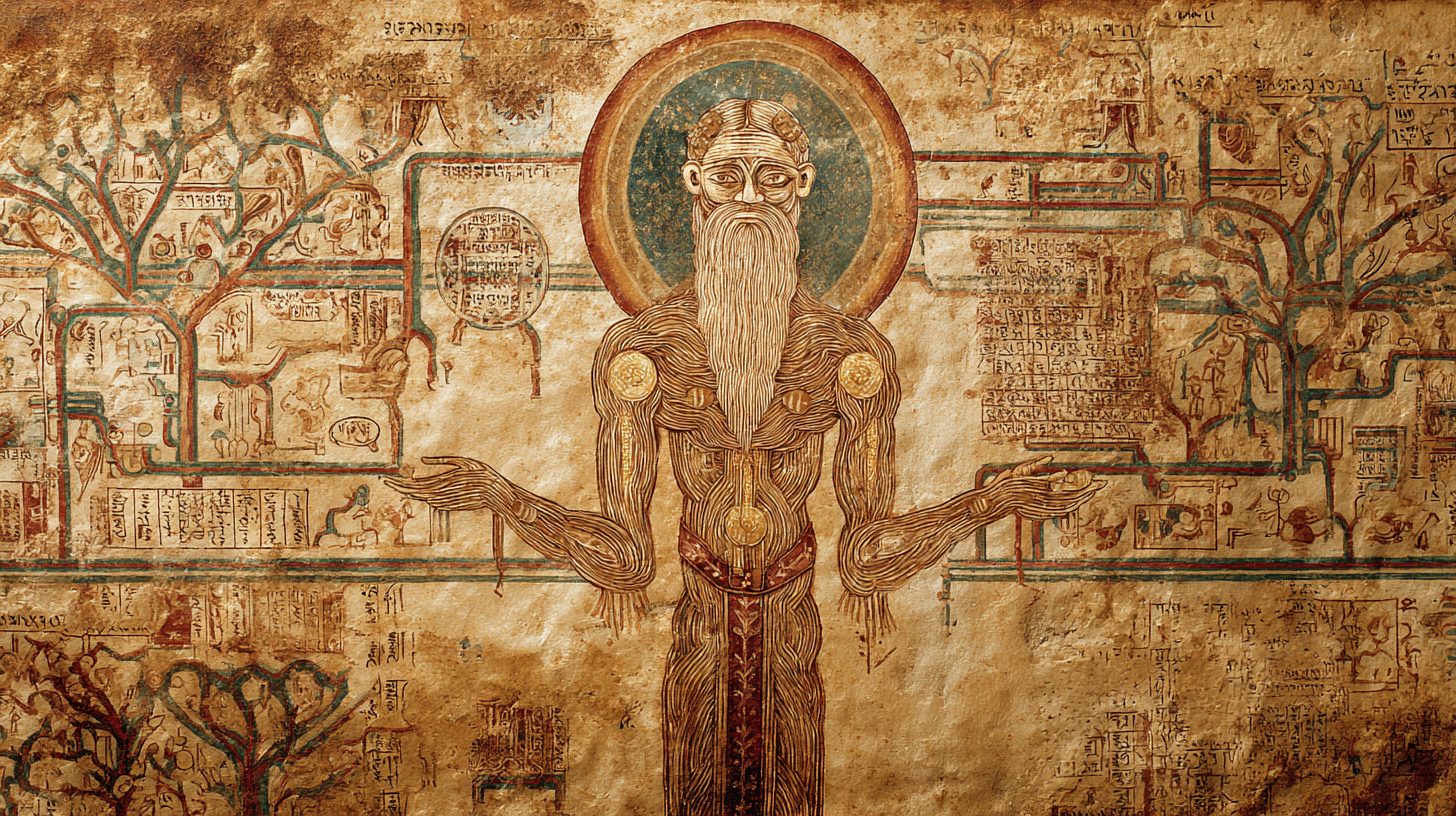
Adam Kadmon: The Primordial Human of the Kabbalah
As Above So Below
The Mind’s Eye: Humanity’s Oldest Inner Vision
Within the vast symbolic architecture of Kabbalah, few concepts are as profound, elusive, and quietly radical as Adam Kadmon. More than a mythic figure, more than a theological abstraction, Adam Kadmon represents the blueprint of existence itself; the primordial pattern from which all reality unfolds. To understand Adam Kadmon is to confront a daring idea at the heart of mystical Judaism: that the universe, consciousness, and humanity share a single archetypal form.
This is not the Adam of Sunday school. Adam Kadmon is not the biblical man fashioned from dust, wandering a garden, or falling from grace. Instead, Adam Kadmon exists before creation as we know it, prior even to time, matter, and differentiation. He is cosmic, infinite, and symbolic rather than biological. In the Kabbalistic worldview, Adam Kadmon is the first configuration of divine light after the Infinite withdraws to allow creation to occur.
To engage seriously with Adam Kadmon is to enter a metaphysical conversation about what it means to be human, what consciousness truly is, and whether the structure of reality mirrors the structure of the self.
The Problem of Creation in Kabbalah
Kabbalah begins with a paradox. God, known as Ein Sof, is infinite, boundless, and without form. If the Divine is infinite, how can anything finite exist at all? How can a world arise without being instantly dissolved into infinity?
The answer offered by Kabbalah is Tzimtzum, the primordial contraction.
Ein Sof withdraws its infinite presence, creating a conceptual “space” in which creation can unfold. Into this space flows divine light, but not chaotically. It enters in a structured, intelligible pattern. That first structured pattern is Adam Kadmon.
Adam Kadmon is not created after the universe. He is the interface between infinity and manifestation. He is the original template that translates divine will into intelligible form. Without Adam Kadmon, creation would be unintelligible, formless, and ungraspable.
Adam Kadmon as the Cosmic Blueprint
The most striking feature of Adam Kadmon is that he is shaped like a human being. This is not anthropomorphism in the crude sense, nor is it an attempt to project human limitations onto God. Instead, Kabbalah suggests something far more unsettling: that the human form reflects a cosmic truth.
In Adam Kadmon, the Sefirot, the ten divine emanations, are arranged in the configuration of a human body. Crown corresponds to consciousness, wisdom and understanding to the brain, mercy and severity to the arms, harmony to the heart, foundation to sexuality, and kingdom to embodiment. This structure is not metaphorical decoration; it is metaphysical anatomy.
The implication is radical. Humanity is not made in the image of God as a poetic flourish. Humanity is made according to the same structural logic as Adam Kadmon. The human nervous system, emotional life, ethical struggles, and capacity for creativity mirror the architecture of the cosmos itself.
To contemplate Adam Kadmon is to realize that consciousness is not an accident. It is the organizing principle of reality.
Adam Kadmon and the Tree of Life
The Tree of Life is the most familiar symbol of Kabbalah, often reduced to a diagram of ten circles connected by lines. Yet when viewed through the lens of Adam Kadmon, the Tree of Life becomes something far more intimate.
Each Sefirah corresponds to a function of consciousness rather than a distant divine attribute. In Adam Kadmon, wisdom is not abstract; it is perception. Mercy is not sentimental; it is expansion. Judgment is not cruelty; it is structure. Harmony is not compromise; it is integration.
When mystics meditate upon Adam Kadmon, they are not worshipping an external figure. They are aligning their own psyche with the original cosmic design. The Tree of Life ceases to be a map of heaven and becomes a diagnostic tool for the soul.
Disorder in the world reflects disorder in consciousness. Repairing the self contributes, however subtly, to the repair of reality. This is the ethical consequence of Adam Kadmon.
The Shattering of the Vessels
If Adam Kadmon represents the perfect blueprint, why is the world so fractured?
Kabbalah answers with the myth of Shevirat ha-Kelim, the shattering of the vessels. When divine light poured into the structures that followed Adam Kadmon, the vessels could not contain its intensity. They shattered, scattering sparks of holiness throughout material reality.
This myth explains suffering without resorting to moral blame. The world is broken not because of human failure alone, but because creation itself is incomplete. Human beings inherit a fractured cosmos and are tasked with its repair.
Adam Kadmon remains intact, untouched by shattering. He stands as a reminder of what wholeness looks like. Spiritual practice, ethical action, and conscious living are methods of realigning fragmented existence with the original pattern of Adam Kadmon.

Adam Kadmon and Human Identity
One of the most provocative aspects of Adam Kadmon is its implication for identity. If humanity reflects a cosmic archetype, then identity is not merely social, biological, or psychological. It is metaphysical.
Gender, personality, and ego are secondary layers. At the deepest level, each individual participates in Adam Kadmon, regardless of form or history.
This offers a quietly subversive vision of human unity, one that predates modern discussions of identity politics by centuries.
The mystical self is not erased; it is expanded. To encounter Adam Kadmon is to recognize oneself as both individual and universal, finite and infinite, embodied and transcendent.
Adam Kadmon and Modern Consciousness
In a technological age dominated by data, algorithms, and artificial intelligence, Adam Kadmon acquires unexpected relevance. He represents an integrated intelligence rather than a fragmented one. Thought, emotion, embodiment, and ethics operate as a unified system.
Modern life often dissects the self into competing functions: productivity versus rest, logic versus feeling, body versus mind. Adam Kadmon offers an alternative model, one in which intelligence is holistic rather than mechanical.
Seen this way, Adam Kadmon is not an ancient relic but a challenge to contemporary culture. He asks whether our technologies reflect wisdom or merely power. Whether our systems mirror coherence or amplify fragmentation.
Adam Kadmon and Tikkun
The ethical heart of Kabbalah is Tikkun, repair. Humanity’s task is not escape from the world but engagement with it. Every act of compassion, restraint, creativity, or truth-telling restores a fragment of the shattered vessels.
Adam Kadmon serves as the compass for this work. He defines the direction of repair. Without a vision of wholeness, repair becomes impossible. Without Adam Kadmon, ethics becomes arbitrary.
Importantly, Tikkun is not perfectionism. It is participation. No individual restores the cosmos alone. Each person contributes a small alignment toward the original pattern embodied in Adam Kadmon.
Why Adam Kadmon Still Matters
The endurance of Adam Kadmon across centuries is not accidental. He persists because he addresses a perennial human question: What am I, really?
Are we biological accidents in an indifferent universe? Are we sinful creatures awaiting redemption? Or are we expressions of a deeper order, temporarily fragmented but inherently meaningful?
Adam Kadmon answers with quiet confidence. Humanity is not fallen trash nor divine puppets. We are fragments of a cosmic design learning, slowly and imperfectly, how to remember itself.
In an age of anxiety, alienation, and overstimulation, Adam Kadmon offers a stabilizing vision. Not certainty, but coherence. Not dogma, but structure. Not escape, but responsibility.
Conclusion: Remembering the Pattern
To study Adam Kadmon is not merely to accumulate esoteric knowledge. It is to remember a pattern that precedes culture, belief, and even language. It is to glimpse a version of humanity that is integrated rather than divided.
Whether approached as myth, metaphysics, or psychological symbolism, Adam Kadmon challenges the reader to consider that meaning is not imposed upon reality but woven into its very structure.
The task, then, is not to become perfect. It is to become aligned. To live, think, and act in ways that echo the original harmony embodied by Adam Kadmon.
And perhaps that is the most radical idea of all: that wholeness is not something to be invented, but something to be remembered.
___________________
The Ten Sefirot: The Inner Anatomy of Adam Kadmon
To move deeper into Kabbalah, we now turn to the Ten Sefirot, the living structure through which divine intelligence flows into creation. If Adam Kadmon is the primordial blueprint, the Sefirot are its internal organs; distinct yet inseparable, dynamic rather than static. They describe how unity becomes multiplicity without losing coherence.
Importantly, the Sefirot are not steps on a ladder to escape the world. They are modes of consciousness through which reality is experienced, shaped, and repaired. In Adam Kadmon, the Sefirot appear in perfect balance. In human life, they often appear distorted, blocked, or exaggerated. Understanding them is therefore an act of self-knowledge as much as cosmology.
Let us move through the Ten Sefirot in their traditional order, from the most subtle to the most embodied, following the descent of consciousness from infinity into lived experience, always with Adam Kadmon as our reference point.
1. Keter – Crown
Keter is the first emanation, the silent source from which all others arise. It represents pure potential, will, and intention before thought takes form. In Adam Kadmon, Keter corresponds to the crown of the head, not as intellect but as awareness itself.
Keter is not something you do. It is something you receive. Moments of stillness, insight, or profound clarity arise from Keter. When this Sefirah is blocked, life feels directionless. When it flows, purpose emerges naturally.
2. Chokhmah – Wisdom
Chokhmah is the flash of insight, the raw spark of intelligence. It is intuitive, fast, and non-verbal. In Adam Kadmon, Chokhmah is the right side of the brain, the moment when something suddenly “clicks.”
This is creativity before refinement, inspiration before explanation. Chokhmah without grounding can feel chaotic. Balanced within Adam Kadmon, it becomes the engine of innovation and vision.
3. Binah – Understanding
Binah receives the spark of Chokhmah and gives it form. It is analytical, reflective, and gestational. Where Chokhmah is lightning, Binah is the storm system that makes sense of it.
In Adam Kadmon, Binah shapes raw insight into structure. Psychologically, it is the capacity to sit with complexity, to think something through, to tolerate ambiguity. Without Binah, wisdom remains unusable.
4. Chesed – Loving kindness
Chesed is expansive generosity, compassion, and openness. It flows outward without restraint. In Adam Kadmon, Chesed forms the right arm, the impulse to give.
Healthy Chesed creates trust, warmth, and connection. Excessive Chesed, however, dissolves boundaries. The lesson of Adam Kadmon is not endless kindness, but kindness in harmony with structure.
5. Gevurah – Strength
Gevurah is restraint, discipline, and discernment. It sets limits, defines boundaries, and says no when necessary. In Adam Kadmon, Gevurah forms the left arm, balancing Chesed.
Without Gevurah, compassion becomes indulgence. Without Chesed, discipline becomes cruelty. Adam Kadmon holds both in tension, reminding us that love without limits and limits without love are equally destructive.
6. Tiferet – Beauty
Tiferet sits at the centre of the Tree and the heart of Adam Kadmon. It is harmony, truth, and integration. Tiferet does not eliminate opposites; it reconciles them.
Psychologically, Tiferet is authenticity. It is where you act in alignment with your values rather than your impulses or fears. When people speak of living “from the heart,” they are describing Tiferet functioning properly within Adam Kadmon.
7. Netzach – Endurance
Netzach represents persistence, drive, and ambition. It is the force that keeps moving forward despite obstacles. In Adam Kadmon, Netzach corresponds to the right leg, the capacity to advance.
Netzach governs motivation and desire. When distorted, it manifests as restlessness or addiction to achievement. When aligned with Adam Kadmon, it becomesposeful perseverance rabrr than compulsive striving.
8. Hod – Splendour
Hod balances Netzach. It governs reflection, communication, and humility. Where Netzach pushes forward, Hod pauses to evaluate. In Adam Kadmon, Hod forms the left leg, enabling balance and coordination.
Hod allows insight to be articulated and shared. Without Hod, ambition becomes reckless. Together, Netzach and Hod teach that movement without reflection is chaos, and reflection without movement is stagnation.
9. Yesod – Foundation
Yesod is the channel through which all higher energies are gathered and transmitted into the physical world. It governs connection, intimacy, and the subconscious. In Adam Kadmon, Yesod corresponds to the reproductive organs.
Yesod is where patterns become habits. Trauma, memory, and desire all converge here. When Yesod is healthy, creativity flows into life seamlessly. When damaged, repetition replaces choice. Adam Kadmon shows Yesod as sacred, not shameful.
10. Malkhut – Kingdom
Malkhut is embodiment, presence, and manifestation. It is the world as lived. In Adam Kadmon, Malkhut is the feet, touching reality directly.
Unlike the other Sefirot, Malkhut has nothing of its own. It receives and expresses. Spirituality that ignores Malkhut becomes escapism. Adam Kadmon insists that enlightenment must walk, eat, speak, and act in the world.
The Living Circuit of Adam Kadmon
The Ten Sefirot are not isolated stages. They form a living circuit, a flow of intelligence cycling endlessly between intention and embodiment. Adam Kadmon is not frozen perfection; he is dynamic equilibrium.
Every ethical choice, every moment of awareness, subtly realigns this circuit. The work is not to ascend permanently into abstraction, but to allow higher awareness to express itself through everyday life.
To live in alignment with Adam Kadmon is to think clearly, feel deeply, act responsibly, and remain open to correction. It is not sainthood. It is integration.
In this sense, the Ten Sefirot are not ancient curiosities. They are a psychological and ethical operating system, quietly waiting to be remembered.