
CORPORATE CHRIST
Virtual Reality and Augmented Reality: Exploring the Possibilities
As Above So Below

Virtual Reality and Augmented Reality: Exploring the Possibilities
Virtual Reality (VR) and Augmented Reality (AR) are no longer fringe technologies reserved for gaming demos and experimental labs. They are fast becoming foundational platforms that will reshape how people work, socialise, learn, and even understand reality itself.
Much like the internet quietly rewired society over a few decades, immersive technologies are now positioning themselves as the next interface layer between humans and the digital world.
At the centre of this transformation sits the concept of the Metaverse, a persistent, shared digital space where physical and virtual realities increasingly overlap.
This article explores how VR and AR may replace current paradigms, how people are likely to live and work in the future, and what all of this means for the so-called “real world”.
From Screens to Spaces
For the last forty years, computing has largely been screen-based. We look at rectangles; we tap, click, and scroll. VR and AR challenge that paradigm entirely. Instead of interacting with flat interfaces, users step inside digital environments or see digital layers seamlessly integrated into their physical surroundings.
Virtual Reality creates fully immersive spaces. Augmented Reality overlays digital information onto the physical world. Mixed Reality blends the two.
Together, they move computing from something we use to something we inhabit. This shift is profound. The Metaverse is not simply a new website or app category; it represents a spatial internet, where presence replaces browsing.
As hardware becomes lighter, cheaper, and more socially acceptable, immersive interaction will feel less like “using technology” and more like inhabiting an expanded version of reality.
The Future of Work: Offices Without Walls
One of the earliest and most impactful changes will occur in how people work. Traditional offices already feel outdated in a world of remote collaboration, cloud software, and global teams.
VR and AR will push this evolution further.
In the Metaverse, virtual offices can replicate the advantages of physical spaces without their constraints. Teams will meet as embodied avatars in shared rooms, whiteboard in three dimensions, manipulate data spatially, and collaborate asynchronously across time zones. Presence will return to remote work, but without commuting, rigid geography, or expensive real estate.
AR will also transform physical workplaces. Engineers, surgeons, and technicians will see live data overlays, guided instructions, and remote expert assistance in real time. Training will shift from manuals and videos to embodied simulations, dramatically reducing learning curves.
The result is a work culture that values output and creativity over location. Careers will become more fluid, global, and project-based, with the Metaverse acting as a professional commons rather than a corporate intranet.
Education Reimagined
Education is another system ripe for reinvention. Current models are still largely based on industrial-age assumptions: classrooms, standardised curricula, and passive learning. VR and AR allow education to become experiential, adaptive, and deeply engaging.
Students will walk through ancient cities, explore the human bloodstream from the inside, or practice complex skills in risk-free simulations. Learning will become something you do, not something you watch. The Metaverse will host virtual campuses, global classrooms, and lifelong learning environments where age, nationality, and physical ability matter far less.
This has profound implications for access. Quality education will no longer be tied to geography or wealth in the same way. While inequality risks still exist, the potential for democratisation is enormous if infrastructure and policy keep pace.
Social Life and Identity in Virtual Spaces
Human beings are social creatures, and social interaction will inevitably migrate into immersive spaces. Early social media flattened identity into profiles and feeds. The Metaverse reintroduces embodiment, expression, and presence.
People will customise avatars that reflect not just how they look, but how they feel.
Identity may become more fluid, playful, and symbolic. For many, especially marginalised groups, virtual spaces will offer freedom from physical constraints, stigma, or danger.
Social venues will proliferate: virtual clubs, galleries, temples, concert halls, and cities that exist entirely in the Metaverse.
These will not replace physical gatherings, but they will complement them, offering connection without distance.
Crucially, social norms will evolve. Concepts such as privacy, consent, reputation, and community governance will need to be redefined for immersive environments. The social contract will be rewritten in code and culture alike.
Commerce, Creativity, and Digital Economies
Economic activity will follow attention and presence. As people spend more time in immersive environments, commerce will move there too. The Metaverse will host new forms of work, trade, and creative expression.
Virtual goods, digital real estate, experiences, and services will become economically meaningful. Designers, architects, performers, educators, and developers will build careers entirely within virtual worlds. Ownership models, whether blockchain-based or otherwise, will underpin these economies.
AR will also reshape physical commerce. Shopping will become contextual and experiential, with digital information enhancing physical products and spaces. The boundary between online and offline retail will dissolve.
Importantly, the Metaverse lowers barriers to entry for creators. Small teams or individuals can build worlds, products, and communities without the overheads of physical infrastructure. This could lead to an explosion of cultural experimentation, alongside intense competition for attention.

The Real World: Diminished or Enhanced?
A common fear is that immersive technologies will detach people from the “real world”. This concern is understandable, but it may be based on a false dichotomy. The real world has always been shaped by tools, symbols, and shared narratives. VR and AR simply make those layers more explicit.
Rather than replacing reality, immersive technologies are likely to augment it. AR in particular will blur the line until “online” and “offline” become outdated terms. The Metaverse will not be a place people escape to, but a layer they move through.
That said, risks are real. Excessive immersion, poorly designed incentives, and corporate enclosure could lead to addiction, alienation, or surveillance. Mental health, digital rights, and ethical design will become central policy issues. How society chooses to govern the Metaverse will matter enormously.
New Paradigms of Meaning and Presence
Beyond economics and productivity lies a deeper question: how will immersive technologies change how people experience meaning?
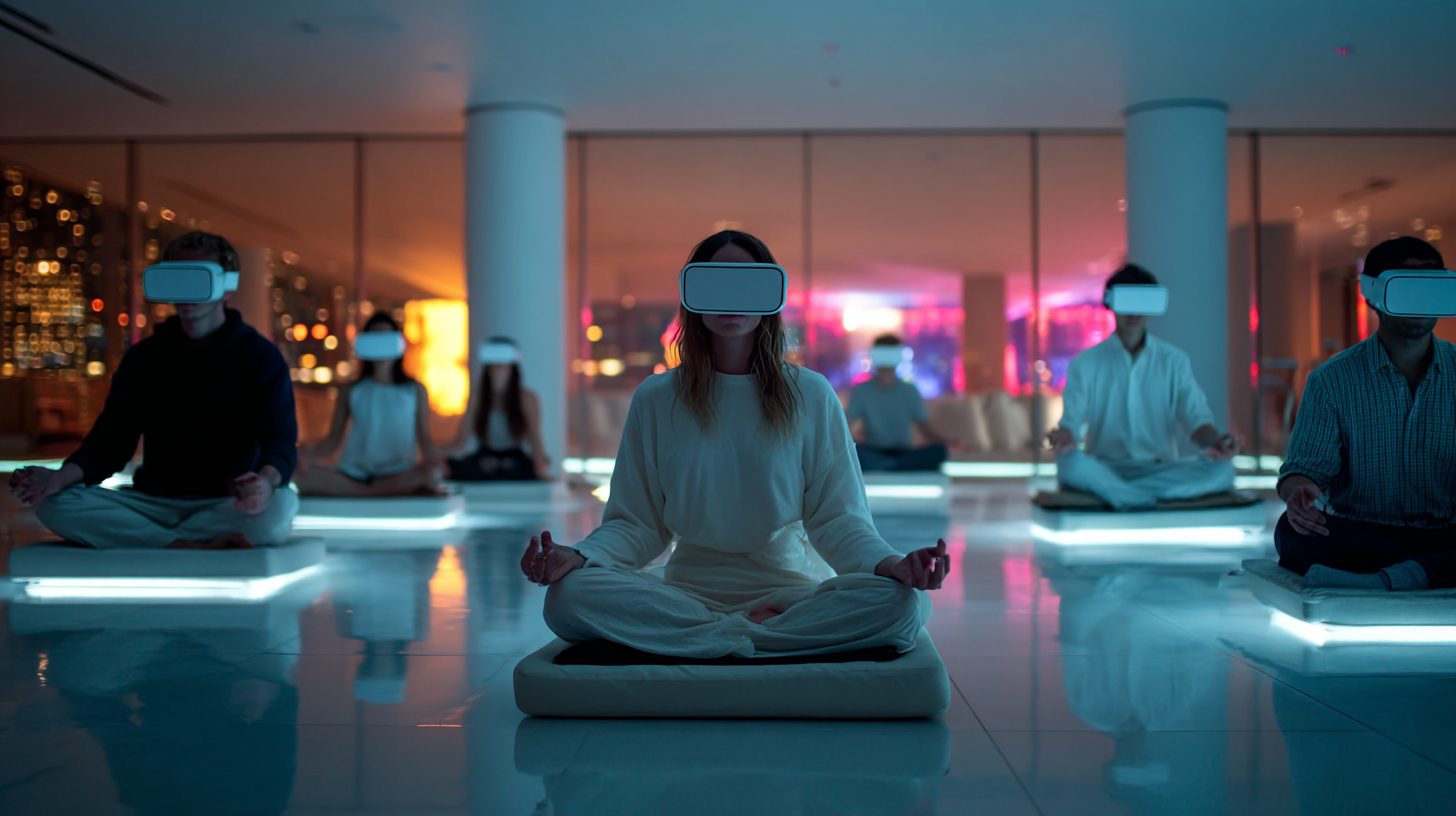
VR allows for ritual, symbolism, and narrative in ways that screens never could. Spiritual practices, therapy, self-exploration, and art will find powerful new forms in immersive spaces.
The Metaverse may become a laboratory for identity, empathy, and psychological growth.
At the same time, the concept of presence itself will evolve. Being “with” someone will no longer require physical proximity. Memory, legacy, and even mourning may take on new digital dimensions. These shifts will challenge traditional ideas about authenticity and value.
What Will Replace Current Paradigms?
Several paradigms are likely to fade or radically transform:
• The fixed workplace, replaced by virtual collaboration spaces.
• Screen-based interfaces, replaced by spatial computing.
• Centralised platforms, challenged by interoperable virtual worlds.
• Passive media consumption, replaced by participatory experiences.
• Rigid identities, replaced by expressive, modular selves.
The Metaverse acts as a convergence point for these changes. It is not a single product or destination, but an ecosystem where VR, AR, AI, and networked culture intersect.
Conclusion: A World Expanded, Not Escaped
Virtual Reality and Augmented Reality represent a shift as significant as the advent of the internet or the smartphone. They change not just what people do, but how they are in relation to technology and each other. The Metaverse will be a mirror, an amplifier, and a testing ground for human values.
Whether this future feels liberating or oppressive will depend less on the technology itself and more on the choices society makes now. Design ethics, governance, accessibility, and cultural imagination will shape whether immersive worlds enrich human life or narrow it.
What seems increasingly clear is this: the boundary between the digital and the physical is dissolving.
The question is no longer whether VR and AR will transform reality, but how intentionally and humanely that transformation will unfold.