
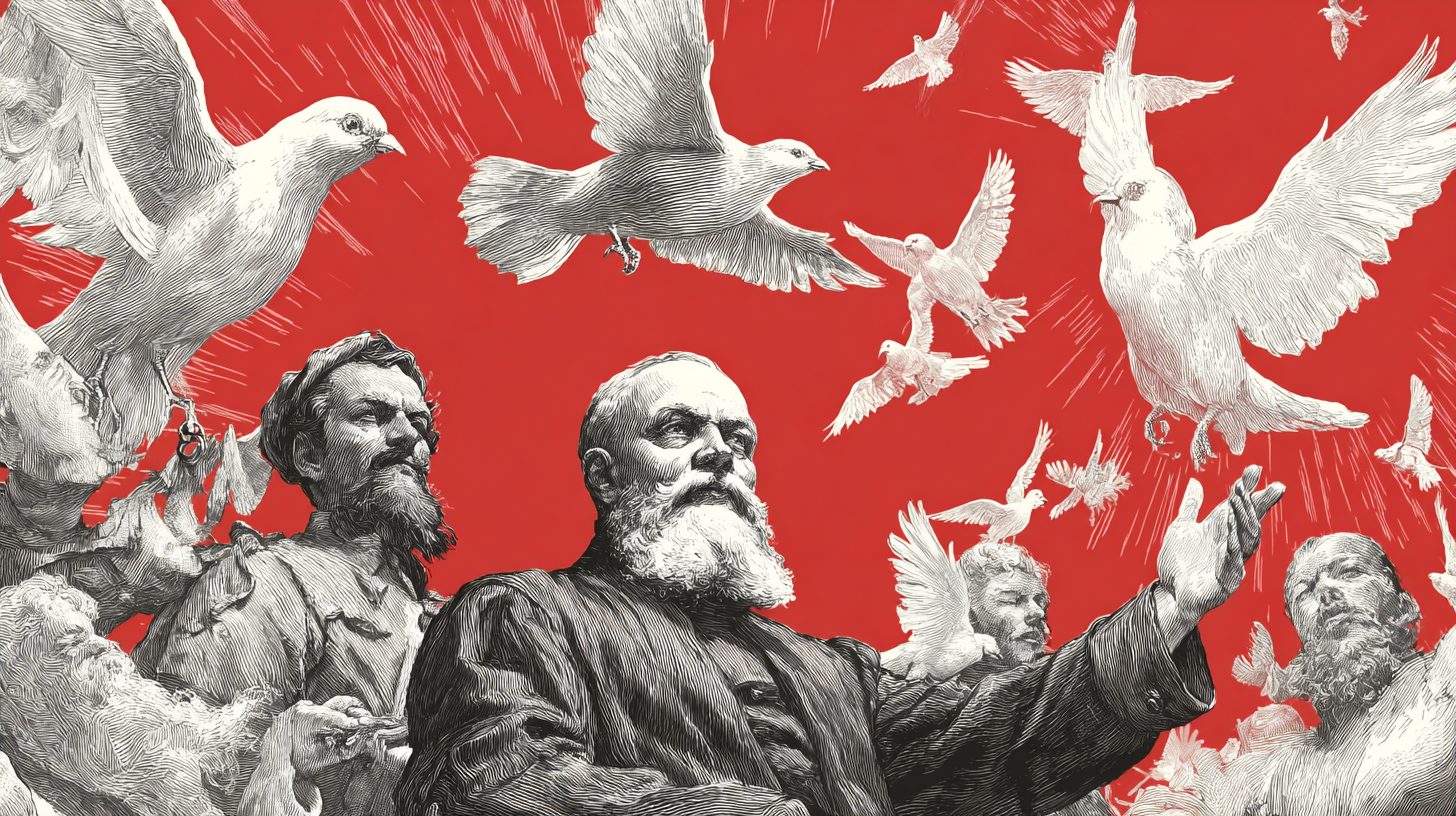
CORPORATE CHRIST
Left-Wing Perspectives on the Relationship between Religion and Politics
As Above So Below

Left-Wing Perspectives on the Relationship between Religion and Politics
The relationship between religion and politics has long been contested, complex, and often contradictory.
Within Left-Wing thought, this relationship is especially nuanced. While the Left-Wing tradition is frequently associated with secularism, materialism, and critiques of institutional power, religion has never been entirely absent from Left-Wing politics. Instead, it has been alternately rejected, reinterpreted, weaponised, and reclaimed. Understanding Left-Wing perspectives on religion and politics requires moving beyond simplistic assumptions and engaging with history, philosophy, and lived political struggles.
This article explores how Left-Wing movements have understood religion, how religious traditions have intersected with Left-Wing politics, and why religion remains politically relevant within Left-Wing discourse today.
Historical Foundations of Left-Wing Thought on Religion
Modern Left-Wing political theory emerged alongside the Enlightenment and the rise of industrial capitalism. Early Left-Wing thinkers were often sharply critical of religious institutions, particularly established churches aligned with monarchy, aristocracy, and colonial power. Religion was frequently viewed as a stabilising force for inequality, offering spiritual consolation instead of material justice.
This critique is most famously articulated by Karl Marx, whose assertion that religion is “the opium of the people” is often misunderstood.
Marx did not simply dismiss religion as illusion; rather, he argued that religion was a symptom of material suffering.
For Marx, Left-Wing politics should focus on eliminating the social conditions that made religious consolation necessary in the first place. From this perspective, Left-Wing politics prioritised economic justice, class struggle, and material emancipation over spiritual narratives.
This foundational position deeply influenced Left-Wing movements throughout the nineteenth and twentieth centuries, embedding secularism into much Left-Wing political culture.
Secularism and the Left-Wing State
As Left-Wing movements gained power, particularly in Europe and parts of Asia, secular governance became a central principle. The Left-Wing commitment to secularism was rooted in concerns about clerical authority, dogma, and the use of religion to justify oppression.
In many contexts, Left-Wing parties championed the separation of church and state as essential to democracy, equality, and freedom of conscience.
In France, for example, Left-Wing politics became closely associated with laïcité, a strict form of secularism designed to limit religious influence in public institutions. Similar Left-Wing positions emerged elsewhere, arguing that public policy should be based on rational debate, empirical evidence, and universal human rights rather than theological doctrine.
However, this Left-Wing secularism was never monolithic. Tensions emerged between the desire to protect individual freedom of belief and the fear that religion, when politicised, could undermine social equality.
Religion as a Tool of Oppression: A Left-Wing Critique
A recurring Left-Wing argument is that religion has historically been used to legitimise hierarchy. From divine kingship to colonial missionary projects, religious narratives have often been intertwined with political domination. Left-Wing critics point to how religious institutions have reinforced patriarchy, opposed LGBTQ+ rights, and resisted scientific progress.
Within this framework, Left-Wing politics positions itself as emancipatory, challenging both economic exploitation and cultural domination. Religion, when aligned with conservative power, becomes a target of Left-Wing critique. This is particularly evident in Left-Wing opposition to religious fundamentalism, whether Christian, Islamic, or otherwise, when it seeks to impose moral codes through state power.
Yet even here, Left-Wing perspectives tend to differentiate between institutional religion and personal belief, a distinction that becomes increasingly important in contemporary politics.
Liberation Theology and Radical Faith
Despite strong secular currents, religion has also inspired explicitly Left-Wing political movements. One of the most significant examples is Liberation Theology, which emerged in Latin America in the mid-twentieth century. Liberation theology reframed Christianity through a Left-Wing lens, emphasising class struggle, economic justice, and solidarity with the poor.
Liberation theologians argued that the message of the Gospel demanded political action against capitalism, imperialism, and structural violence.
This fusion of faith and Left-Wing politics challenged the assumption that religion must inherently serve conservative interests. Instead, religion became a vehicle for revolutionary consciousness.
This tradition highlights an important dimension of Left-Wing perspectives: religion is not inherently reactionary; its political meaning depends on interpretation, context, and power relations.
Social Democracy, Moral Language, and Religion
In many social democratic movements, particularly in Europe, religion has played a quieter but still significant role.
Left-Wing parties advocating welfare states, labour rights, and social protection have often drawn, implicitly or explicitly, on moral frameworks historically shaped by religious ethics.
Concepts such as human dignity, solidarity, and care for the vulnerable resonate across both religious traditions and Left-Wing political philosophy. While social democratic Left-Wing movements typically avoid overt theological claims, they frequently employ ethical language that mirrors religious moral teachings.
This overlap has allowed Left-Wing politics to engage religious voters without abandoning secular governance, creating pragmatic alliances in pluralistic societies.
Anti-Colonialism and Left-Wing Religious Politics
In anti-colonial struggles, religion has often functioned as a source of resistance rather than oppression. Many Left-Wing liberation movements in Africa, Asia, and the Middle East incorporated religious identity into broader struggles against imperial rule.
From this perspective, Left-Wing politics recognises that religion can serve as a unifying cultural force, particularly where colonial powers attempted to suppress indigenous traditions. Here, Left-Wing analysis focuses less on abstract secularism and more on material conditions, cultural autonomy, and self-determination.
This history complicates Western Left-Wing assumptions about religion, demonstrating that Left-Wing politics must be context-sensitive rather than ideologically rigid.
Contemporary Left-Wing Politics and Religious Pluralism
In the twenty-first century, Left-Wing perspectives on religion and politics are shaped by multiculturalism, migration, and identity politics. Many Left-Wing movements now prioritise religious freedom as part of broader commitments to minority rights and social inclusion.
This shift has created internal debates within the Left-Wing. Some argue that accommodating religious practices risks undermining secular values, gender equality, or LGBTQ+ rights. Others contend that a genuinely Left-Wing politics must defend the rights of religious minorities against discrimination, even when religious beliefs differ from progressive norms.
These debates reflect a broader Left-Wing struggle to balance universalism with respect for difference, and structural critique with lived experience.
Left-Wing Populism and Moral Authority
Recent years have seen the rise of Left-Wing populist movements that challenge
neoliberalism and elite power structures. While often secular, these movements frequently adopt moral narratives that echo religious language, framing politics as a struggle between justice and corruption, solidarity and greed.
Figures such as Jeremy Corbyn illustrate how Left-Wing politics can draw on ethical traditions, including religious influences, without promoting institutional religion. This approach appeals to voters seeking moral clarity in an era of economic precarity and political cynicism.
Here, Left-Wing politics operates in a symbolic space once dominated by religion, offering meaning, purpose, and collective identity.
Critiques from Within the Left-Wing
Not all Left-Wing thinkers are comfortable with renewed engagement between religion and politics. Some argue that any political use of religion risks reinforcing irrationalism or undermining scientific reasoning. Others worry that religious narratives can be selectively interpreted to justify authoritarianism, even within Left-Wing movements.
These critiques highlight the enduring tension within Left-Wing thought between materialist analysis and symbolic meaning. The challenge lies in addressing spiritual and moral needs without surrendering critical inquiry or democratic accountability.
The Future of Left-Wing Religion–Politics Relations
Looking ahead, Left-Wing perspectives on the relationship between religion and politics are likely to remain diverse and contested. As societies become more pluralistic and inequalities deepen, questions of meaning, ethics, and belonging will continue to shape political life.
Rather than a simple rejection or embrace of religion, contemporary Left-Wing politics increasingly adopts a pragmatic stance. Religion is treated neither as an enemy nor as an unquestioned ally, but as a social force that must be critically engaged.
In this sense, Left-Wing perspectives emphasise context, power, and outcomes. The central question is not whether religion belongs in politics, but whether its political use advances or undermines equality, justice, and human flourishing.
Conclusion
The relationship between religion and politics within Left-Wing thought defies easy categorisation. Historically sceptical of religious authority, Left-Wing movements have nonetheless engaged with religion in complex and sometimes transformative ways. From Marxist critique to liberation theology, from secular governance to moral populism, Left-Wing perspectives reveal a dynamic interplay between belief, power, and social change.
Ultimately, Left-Wing politics remains defined less by its stance on religion itself and more by its commitment to dismantling oppression.
Whether religion functions as a tool of domination or liberation depends not on doctrine alone, but on who wields power, whose interests are served, and whether political action moves society closer to justice.
In that sense, the Left-Wing conversation about religion and politics is not settled. It is ongoing, evolving, and inseparable from the broader struggle to imagine a more equitable world.